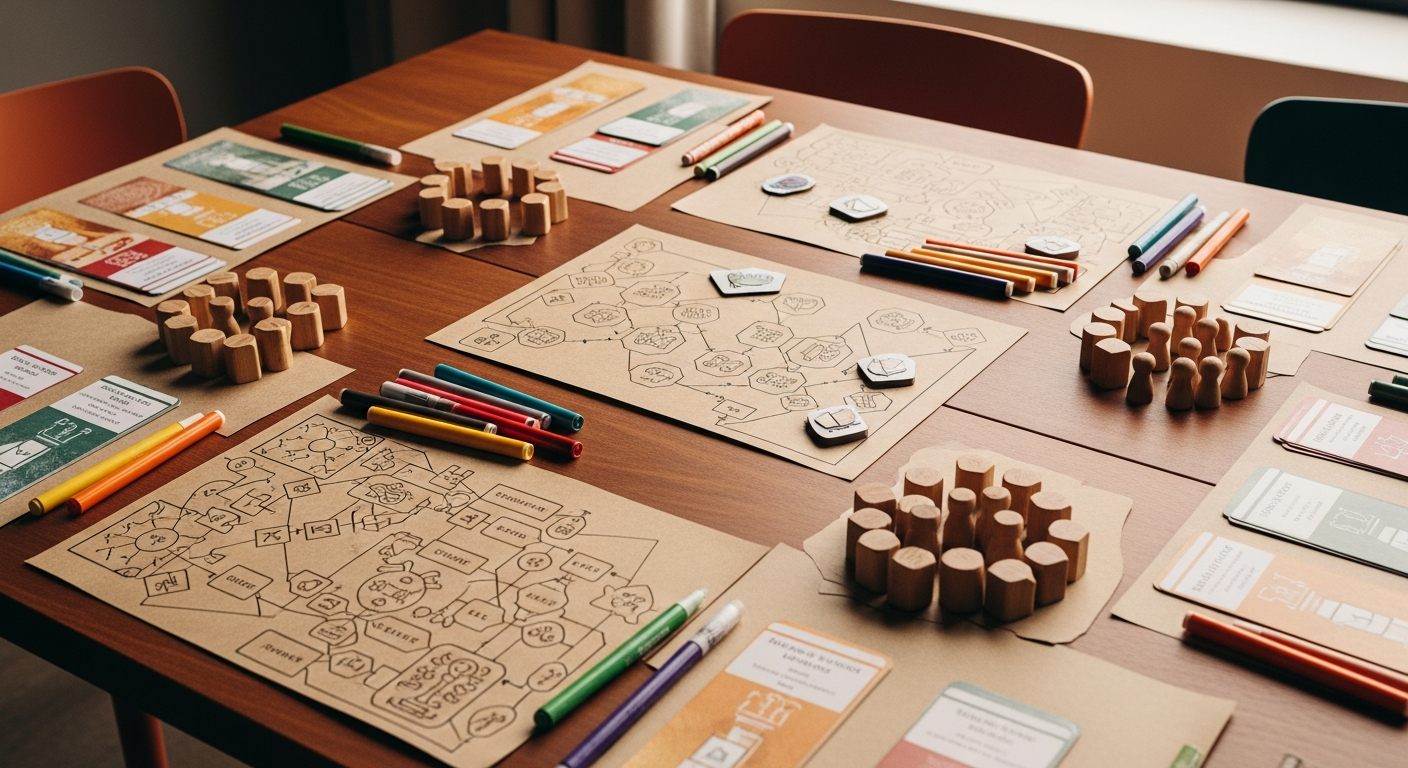
A facilitated, game-based workshop where cross-functional teams use structured play to surface systemic bottlenecks, reframe stubborn challenges, and prototype actionable solutions — all within a single intensive session.
Why Play Works Where Meetings Fail
Traditional brainstorming flattens hierarchy on paper but rarely in practice. Game mechanics — turn-taking, resource constraints, visible scoring — create genuine parity among participants. A junior engineer’s insight carries the same weight as a VP’s directive when both are playing by the same rules. The workshop harnesses this leveling force to unlock perspectives that status-driven meetings consistently suppress.
Each session is built around your team’s actual challenges. Before the workshop, I conduct a brief diagnostic interview to understand the system you’re operating within — the feedback loops, incentive misalignments, and information bottlenecks that shape your problem space. The game scenario your team plays is custom-designed from that intake, not pulled from a generic facilitation deck.
What a Session Looks Like
- System mapping warm-up: Teams collaboratively map the current state of their problem as an interconnected system — actors, flows, delays, and reinforcing loops made visible on a shared canvas.
- Constraint game rounds: Structured play rounds introduce resource limits, role reversals, and competing objectives that mirror real organizational dynamics, forcing creative reframing.
- Solution prototyping sprint: Teams translate game-round insights into concrete intervention proposals, scored against feasibility, systemic leverage, and measurable impact.
- Debrief and prioritization: A facilitated retrospective connects game outcomes to real organizational decisions, producing a ranked action list the team can execute immediately.
The game made invisible power dynamics visible in twenty minutes. We solved a prioritization conflict that had stalled us for two quarters.
Head of Product, Series B fintech
Who This Is For
Product teams stuck in cyclical debates. Leadership groups navigating organizational transformation. Cross-functional squads launching a new initiative who need shared mental models before they write a single line of code. The workshop scales from eight participants to thirty — intimate enough for candid dialogue, large enough to represent the full system.

What You Walk Away With
Every team leaves with three tangible deliverables: a visual system map of their challenge domain, a prioritized list of high-leverage interventions scored during play, and a facilitation guide so they can run lighter versions of the game internally. The workshop doesn’t end when the timer stops — it installs a repeatable practice your organization can use long after I leave the room.