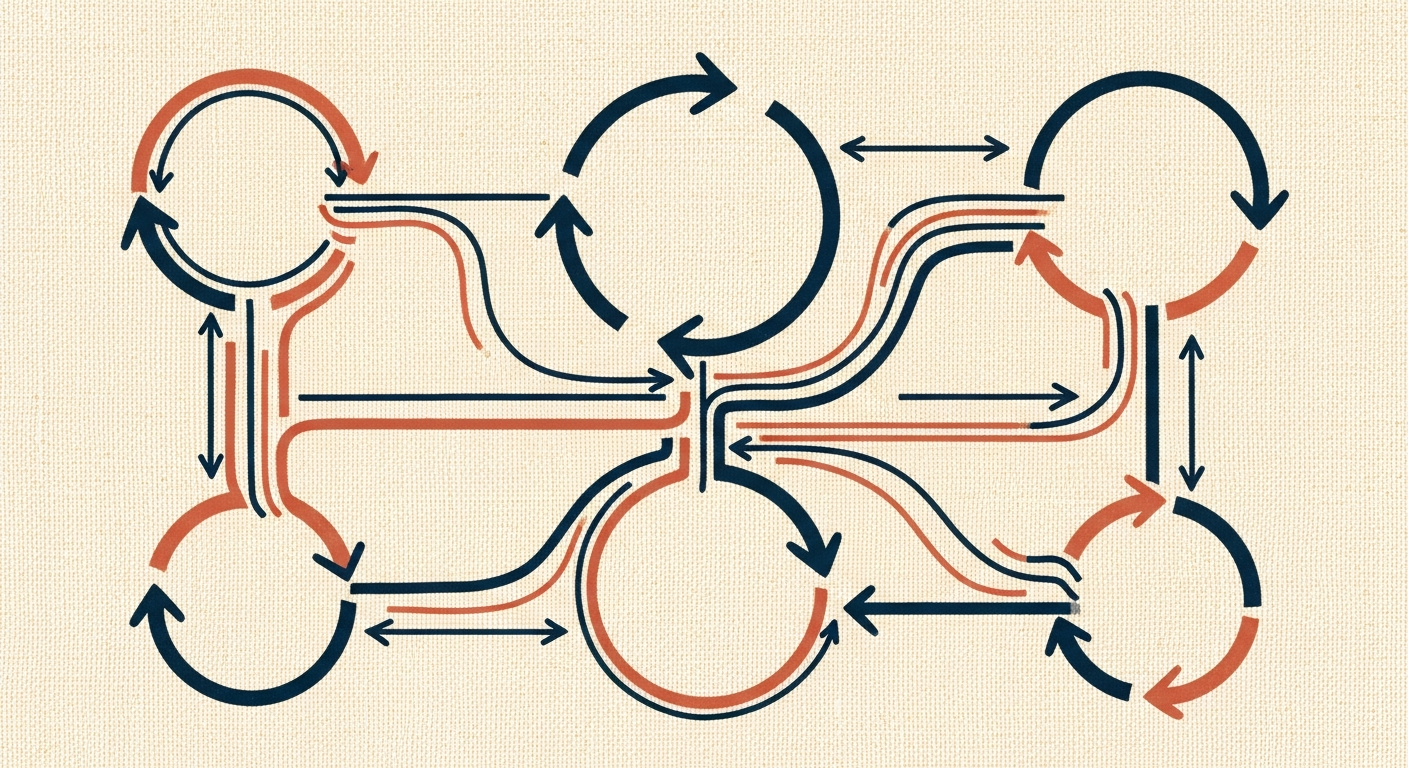
Every product is a living system of cause and effect. Understanding how feedback loops amplify or dampen user behavior is the first step toward designing experiences that evolve gracefully rather than spiraling out of control.
Two Flavors of Loop
Reinforcing loops compound change. A user completes a task, earns visible progress, feels competent, and returns to complete more. The loop feeds itself — engagement begets engagement. Left unchecked, reinforcing loops can also compound negative behavior: a confusing onboarding flow drives drop-offs, which reduces social proof, which drives more drop-offs.
Balancing loops restore equilibrium. A notification system that throttles alerts when a user marks too many as irrelevant is a balancing loop. So is a pricing tier that caps usage before server costs outpace revenue. These loops are the guardrails that keep the system sustainable.
Mapping Loops in Practice
I start every engagement by drawing the system’s core loops on a whiteboard. The exercise is deceptively simple: name the actors, name the actions, draw the arrows, and label each connection as “same direction” (reinforcing) or “opposite direction” (balancing). Within thirty minutes, product teams begin seeing dynamics they’d only felt intuitively — why churn spikes after a feature launch, or why a referral program plateaued.
The map is not the territory, but a good map reveals leverage points the territory hides in plain sight.
Where Gamification Enters
Gamification, when done thoughtfully, is the art of designing reinforcing loops that align business goals with user motivation. A well-placed progress bar doesn’t just decorate the interface — it closes a feedback loop between effort and visible advancement. The key is ensuring the loop rewards genuine value creation rather than hollow vanity metrics.
In future essays I’ll explore specific loop archetypes — the “engagement flywheel,” the “mastery ladder,” the “social proof spiral” — and show how each maps to concrete UX patterns. For now, the invitation is simple: the next time your product data surprises you, ask which loop is responsible.
Leave a Reply