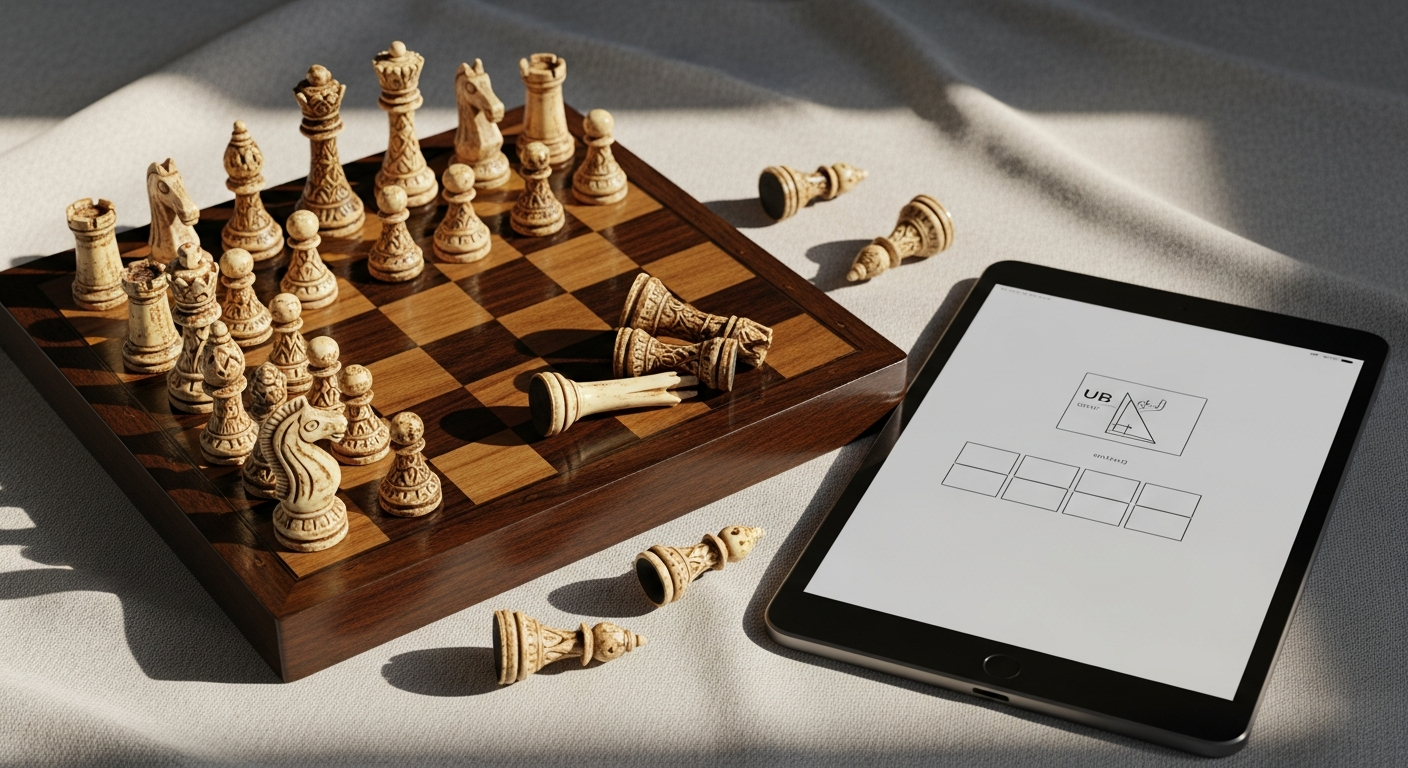
The history of game design in the Persian-speaking world stretches back more than a millennium — and its principles resonate with surprising directness in contemporary interaction design. This is a brief meditation on what classical games can teach us about modern UX.
Shatranj: Constraint as Creative Engine
Shatranj — the Persian ancestor of modern chess — is a masterclass in designed constraint. Each piece has a limited, precisely defined movement vocabulary. The richness of the game emerges not despite these constraints but because of them. Every constraint eliminates a class of trivial decisions and forces the player toward more meaningful ones.
Modern UX operates on the same principle. The best interfaces don’t offer infinite freedom; they constrain the decision space so that every remaining choice feels significant. A well-designed onboarding flow, like a well-designed chess opening, limits options at each step to guide the user toward competence without overwhelming them.
In Shatranj, the Counsellor moves only one diagonal square — the weakest piece on the board. Yet the game endured for centuries. Power is not prerequisite for depth.
Backgammon and Probabilistic Thinking
Nard — the Persian precursor to backgammon — introduced controlled randomness as a design element. The dice inject uncertainty; the board geometry provides structure. Players must make optimal decisions within a probabilistic space, balancing risk against position. This is precisely the cognitive model behind modern A/B testing dashboards, portfolio risk interfaces, and any product that asks users to make decisions under uncertainty.
When I design gamification systems, I often return to Nard’s core question: how much uncertainty makes the experience exciting without making it feel arbitrary? Too little randomness produces boredom; too much produces helplessness. The sweet spot — what game designers call “meaningful randomness” — is where engagement lives.
Design Principles That Endure
Both Shatranj and Nard share a design philosophy that contemporary UX would benefit from revisiting: elegance through reduction. Neither game requires a tutorial. The rules fit on an index card. Mastery, however, takes a lifetime. This gap between “easy to learn” and “impossible to exhaust” is the hallmark of enduring design — whether the artifact is a twelfth-century board game or a twenty-first-century product interface.
As someone who works at the intersection of Persian and Western design traditions, I find these ancestral games a constant source of practical insight. They remind me that the most powerful design decisions are often subtractive — removing options, simplifying rules, trusting the user’s intelligence — and that the best systems are the ones that reveal their depth slowly, rewarding attention and patience over time.
Leave a Reply