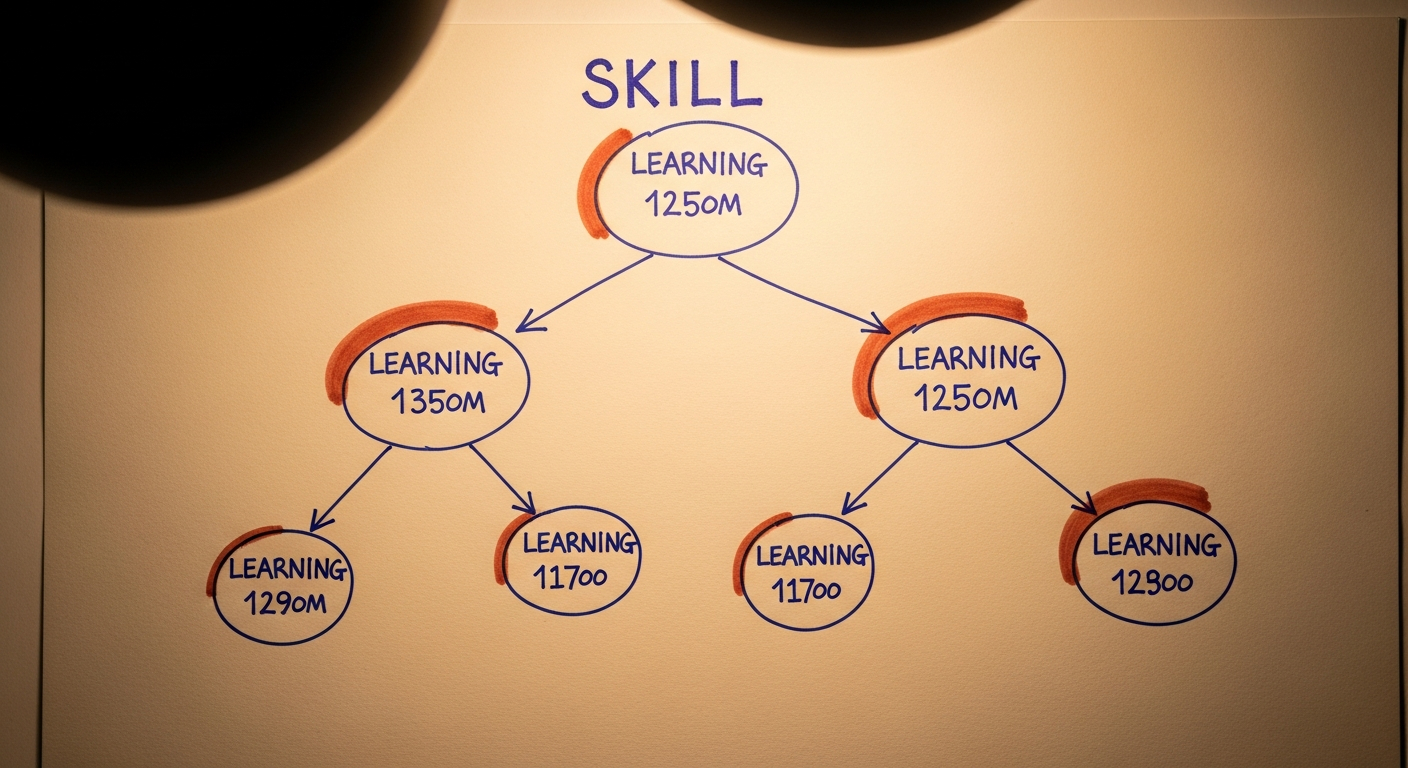
Danesh Academy offered rigorous online courses in data science and product management, but completion rates hovered below 30%. By replacing their linear curriculum with a skill-tree progression system — complete with adaptive difficulty and reward pacing — we reduced drop-off by 35% and transformed passive video-watchers into active learners who chose their own path through the material.
The Challenge
Danesh Academy’s courses were well-produced and taught by respected practitioners. But the platform’s structure was strictly linear: Module 1, then Module 2, then Module 3 — twelve modules, one path, no branching. Learners who found early modules too easy grew bored; those who hit a difficult module without sufficient prerequisite understanding gave up. Both failure modes produced the same outcome: abandonment.
The team had experimented with “skip ahead” buttons and optional quizzes, but without a coherent progression model these features felt arbitrary. Learners didn’t know what they were skipping toward or why a quiz result mattered. The platform needed a structural redesign, not more features bolted onto a broken spine.
The Approach
I began by mapping the curriculum’s knowledge graph — the actual dependency relationships between concepts, not the arbitrary module sequence. Data cleaning doesn’t require understanding data visualization, but it does require understanding data types. Regression analysis requires both. These dependencies formed a directed acyclic graph that became the skeleton of the new skill tree.
With the knowledge graph established, I designed three interlocking systems: a branching skill tree that gave learners visible choice over which path to pursue next, an adaptive difficulty engine that adjusted exercise complexity based on assessment performance, and a reward-pacing layer that ensured learners experienced a “competence moment” — a tangible demonstration of new capability — at regular intervals throughout the tree.

Design Principles
- Visible choice, bounded complexity. At any node in the skill tree, learners could see two or three unlocked paths ahead. More than three created decision paralysis; fewer than two felt like a return to the old linear track. The sweet spot was structural freedom within clear constraints.
- Adaptive difficulty through diagnostic gates. Each skill-tree node began with a brief diagnostic assessment. Learners who demonstrated existing competence skipped the instructional content and went directly to the applied exercise. Those who didn’t received the full module. This respected experienced learners’ time without abandoning beginners.
- Competence moments every three nodes. After completing three skill-tree nodes in any path, learners reached a “capstone challenge” — a realistic, applied problem that synthesized what they’d learned. These weren’t graded exams; they were demonstrations of capability that learners could share on LinkedIn or include in a portfolio.
- Effort-calibrated rewards. XP earned from a node scaled with its difficulty rating, ensuring that learners who took harder paths weren’t penalized in the progression system relative to those who chose easier routes. The reward pacing reflected actual learning effort, not arbitrary point values.
The Outcome
Course completion rates rose from 28% to 42% — a 35% reduction in drop-off. Average time-to-completion decreased by 18% because experienced learners no longer sat through material they already understood. Learner satisfaction scores increased across all cohorts, and Danesh Academy reported a 27% increase in course referrals, driven largely by the shareability of capstone challenge outputs.
Perhaps most tellingly, the data showed that learners who used the branching paths completed more total nodes than those on the old linear track — they weren’t shortcutting the curriculum, they were exploring more of it. Choice didn’t reduce rigor; it increased engagement with the material.
A linear curriculum assumes every learner is the same person at the same starting point. A skill tree assumes they’re not — and that’s closer to the truth.
Amin Ebrahimi


Leave a Reply