Vantage Sales Group’s 200-person team had a powerful CRM that almost nobody wanted to use. By layering a points-and-missions system onto the existing platform — designed through systems mapping rather than surface-level badges — we turned reluctant data entry into a competitive daily practice that sales reps actually looked forward to.
The Challenge
Vantage had invested heavily in a legacy CRM over three years, but adoption had plateaued at around 40% daily active usage. Sales managers spent hours chasing reps to log calls and update deal stages. The data gap meant forecasting was unreliable, pipeline reviews were based on guesswork, and the executive team was considering scrapping the platform entirely.
Previous attempts at gamification — a simple leaderboard, monthly prizes for top loggers — had produced short spikes followed by rapid decay. The interventions targeted symptoms without understanding the underlying system dynamics that made the CRM feel like overhead rather than an asset.
The Approach
I started by interviewing fifteen reps across three regional teams — not about the CRM, but about what made their best sales days feel rewarding. The patterns were consistent: momentum from back-to-back calls, the satisfaction of moving a deal forward, and the social energy of seeing teammates close. The CRM captured none of these dynamics.
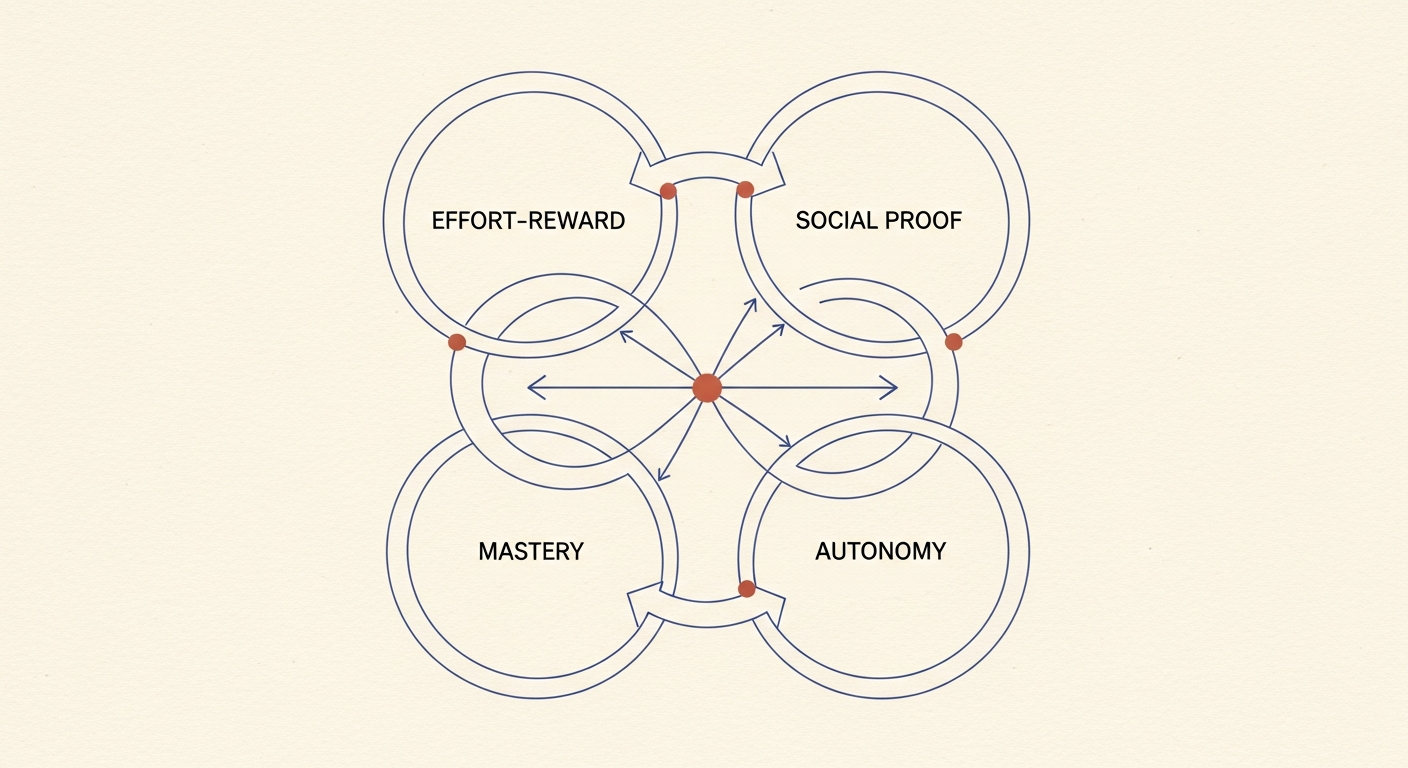
Using those interviews, I built a systems model of rep motivation that mapped four interacting loops: effort-reward (immediate feedback on logged activity), social proof (visibility of peer momentum), mastery progression (skill recognition over time), and autonomy (control over which missions to pursue). The gamification layer was designed to amplify all four simultaneously.
Design Decisions
- Daily missions over monthly contests. Each morning, reps received three optional missions tailored to their pipeline — “Log two discovery calls,” “Update three deal stages,” “Add a contact from yesterday’s meeting.” Completing all three unlocked a small XP bonus, creating a daily completion loop.
- Team momentum pulse. A real-time, anonymized activity feed showed the team’s collective pace — not individual rankings. This triggered social proof without the toxicity of stack-ranking, and it created a shared sense of “we’re all moving today.”
- Mastery tiers. Reps earned progression badges for sustained consistency, not volume spikes. Logging data for twenty consecutive business days mattered more than logging fifty entries in one week. This rewarded the behavior the organization actually needed.
- Mission autonomy. Reps could swap one daily mission for an alternative from a curated set, preserving a sense of agency. Research on self-determination theory predicted — and data confirmed — that this single affordance increased mission completion rates by 23%.
The Outcome
Within one quarter, daily active usage rose from 40% to 63% — a 58% relative increase. Forecast accuracy improved by 31% as pipeline data became more current. The executive team shelved the CRM replacement initiative. More importantly, the gains held: six months later, daily active usage was still at 61%, showing that the system’s feedback loops were self-sustaining rather than novelty-dependent.
The difference between a leaderboard that dies in three weeks and a system that holds for six months is whether you designed for the loops or for the scoreboard.
Amin Ebrahimi

Leave a Reply